

|
|
|
|
||||||||||||||||||||||
| Go To The New York Sun Home Page
Robots (Probably) Won’t Turn Against Humanity, Experts Say in Their Defense By ERIC WOLFF Staff Reporter of the Sun The trailer for “I, Robot” shows a tidal wave of superior mechanical androids attacking humanity en masse. It’s a sinister vision of the future, but that doesn’t seem to concern the world’s leading robot makers. A spokesman at Honda, whose ASIMO robot is humanoid in shape and height, said the company doesn’t take such evil-robot fears very seriously. “ASIMO is designed by people. It’s designed to help people,” said the leader of the ASIMO North America Project, Jeffrey Smith.“It’s designed to do good.” The robots in the film are also designed to do good, however, and many characters maintain robots can’t possibly harm humans because of the three laws of robotics encoded into their computerized brains. The first law is not to harm people; the second is to obey people as long as doing so doesn’t conflict with the first law, and the third is that the robot should protect itself as long as it doesn’t conflict with the first two laws. Officials at Sony, the makers of QRIO, a 2-foot-tall robot with the ability to recognize individual faces,were so concerned about the images portrayed by the film that they didn’t want to comment for this story. “We don’t want to participate in a piece associated with the film,” said a spokesman, John Dolak. While Sony’s robot dog, AIBO, has yet to cause harm to anyone, software developers like those at aibopet.com are selling downloadable programs to change AIBO’s personalities, help him make different sounds, and even imitate movie characters like the villainous robots from Battlestar Galactica. If little robotic dogs can be hacked, some wonder if the human-sized robots can truly escape interference. Only movie critics have seen the film so far,but some robotics experts feel the trailer alone could be a public relations fiasco for their mechanized friends. “The message is that they are dangerous and they will potentially have the ability to harm biological humans,” said a New York University professor of computer science, Demetri Terzopoulos. A spokeswoman for 20th Century Fox did not return telephone calls yesterday seeking comment. Mr.Terzopoulos said the trend of denigrating robots in movies is hardly new, considering the long history of movies, like the “Terminator” films and “Blade Runner,” in which anthropomorphized machines menace humanity. Indeed, the movie, which opens Friday, is based on a 1950 book by Isaac Asimov. “It puts things in a fairly bad light,” said a Carnegie Mellon University computer science professor who specializes in artificial intelligence, Reid Simmons. “In some sense this is a universal problem. You get immigrants from a country that are looked on suspiciously, and people in the past don’t want to have immigration because they might take over.’ People ultimately learn,Mr.Simmons said, that this is not a realistic fear. Robots have made a lot of progress in recent years, but the basic nature of recent advances shows just how far society is from an “I, Robot” future. ASIMO’s major achievement is the ability to walk up and down stairs. QRIO can recognize and remember individual faces. Last year a piece of software taught itself to play backgammon to rival world champions. But the challenges are still enormous. “Robots are very limited in perception, behavioral intelligence, and higher cognitive skills — really every level of intelligence,” Mr. Terzopolous said. That said, all of the experts interviewed for this article agreed that robots with intelligence levels found in “I, Robot” aren’t just possible — they’re inevitable. “Robots today are at about the same place computers were 40 years ago,” Mr. Simmons said. The movie takes place in 2038 — just 34 years away. 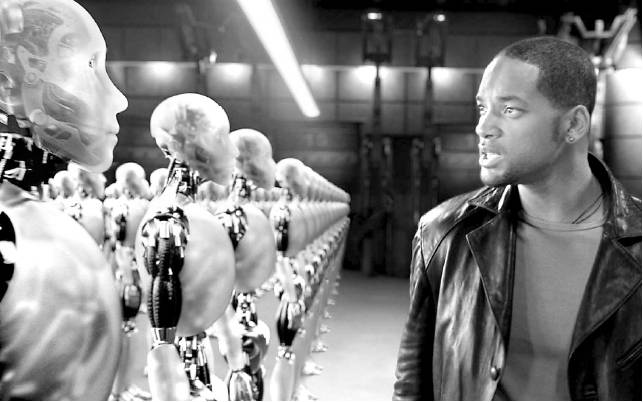 WHEN ROBOTS GO BAD On the hunt for a murderer, Chicago Police Detective Del Spooner (Will Smith) takes a close look at one of several thousand suspects in the movie ‘I,Robot.’ AP /DIGITAL DOMAIN |
||||||||||||||||||||||
| ||||||||||||||||||||||