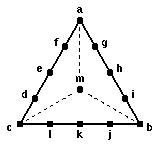
THIRTEEN RESPONSES |
CHOICES |
If totally sure use a definite, a, b, c response.
If totally unsure use an m response.
If see one definitely wrong a, b, c value, choose among the remaining five on the opposite line.
Indicate preference between two values by d, f, g, i, j, l responses.
Indicate uncertainty between two values by e, h, k
responses.
| Choice | Letter | Points | Fraction |
|---|---|---|---|
| Correct | a b c | 30 | 1.000 |
| Wrong | -100 | 0.000 | |
| Uninformed | m | 0 | 0.769 |
| Near Right | d f g i j l | 20 | 0.923 |
| Between Two | e h k | 10 | 0.846 |
| Near Wrong | d f g i j l | -10 | 0.692 |
| a | b | c | |
|---|---|---|---|
| a | 30 | -100 | -100 |
| b | -100 | 30 | -100 |
| c | -100 | -100 | 30 |
| d | -10 | -100 | 20 |
| e | 10 | -100 | 10 |
| f | 20 | -100 | -10 |
| g | 20 | -10 | -100 |
| h | 10 | 10 | -100 |
| i | -10 | 20 | -100 |
| j | -100 | 20 | -10 |
| k | -100 | 10 | 10 |
| l | -100 | -10 | 20 |
| m | 0 | 0 | 0 |
The definition of risk is expected loss.
Rows indicate points given to a through m answers when the respective column headings are true.
The loss-matrix values cause minimum risk only when a, b, c is answered when more than 95% certain. Otherwise there is a strong preference for an m response. Thus unless truly knowledgeable about the test question, students not following the rule "answer a, b, c only when certain" fall below the upper levels.