Large Numbers

Large Numbers

Allen Klinger, © 5/30/2009

Words and signs are short ways of writing about very big quantities: Notation. Two multiplication or times methods make it easier to handle such huge numbers as how many grains of sand are on a beach, what different card hands are possible, and how many electrons are in the universe. Instead of fingers and toes people use words - spoken sounds - and signs - drawn pictures - for amounts. Some words, hundred, thousand, and million, are commonly understood. But others aren't.

Questions like how much?, how many? come up often. They make invented words and signs about numbers useful and worth knowing more about. This material focuses on two kinds, both based on repeated multiplication. The first involves different numbers and is called factorial. The second has the same number as a factor many times. It is called power.

In 1808 Christian Kramp [12] first used n!, today the factorial, for the product of the integers (ordinary numbers) from 1 to n. Factorial comes up in practical situations: it is the answer to the question how many different ways can one arrange n items? (E.g., playing cards). For instance, if given four cups, ones colored blue (B), red (R), orange (O), and green (G), here are five of the 4! = 4(3)(2)1 = 24 ways they can be arranged:

BROG, RBOG, ORBG, GROB, BGOR

Many sciences - e.g., astronomy and biology - use large or small amounts, recording them using multiples of some number times itself: two in computers; ten for money.

The exponent is a small number above and right of a number used in repeated multiplication like two or ten. It means number of repeats in the multiplication; these statements use 2 and 3 exponents:

102 = 100 and 23 = 8

Some words specify how many times a number is multiplied times itself, like thousand for ten with exponent three; and thousandth for ten with exponent minus three (milli).

10 cents = 1 dime; 10 dimes = 1 dollar so 100 cents = 10 times 10 cents = 102 cents = 1 dollar

Question 1.What value is 7! ?
Question 2.What do we call ! ?
Question 3.Which words match up with the symbols 103 and 106 (hint - hundred, thousand, million, billion)?

Example 1. A comparison of 3(2)1 and 4(3)(2)1 yields a ratio of 4.
Example 2. What is the size of 17! = (17)(16)(15)(14)(13)(12)(11)(10)(9)(8)(7)(6)(5)(4)(3)(2)(1)?


Factorial grows very rapidly. For n small here are the computations and the first few values, showing its growth:
n n(n-1)(n-2)...(2)1 = n!
1 1 = 1
2 2(1) = 2
3 3(2)(1) = 6
4 4(3)(2)(1) = 24
5 5(4)(3)(2)(1) = 120
6 6(5)(4)(3)(2)(1) = 720

There are three ways to represent size. Scientific work uses factorial and expontents because they make concise descriptions of very large quantities. A third way uses language: special words such as undecennary. Scientists also use the word notation to describe such short writing techniques. The next two items show how to get an idea about size from these nonword, numerical ways to jot things down.

If we replace a number in a product by a smaller one then we know that we'll get a smaller result.
"(A) > (B)" means that (A) is bigger than (B). With 17 > 10, 16 > 10, 15 > 10, 14 > 10, 13 > 10, 12 > 10 and 11 > 10,

17! = 17(16)(15)(14)(13)(12)(11)(10!) > 10(10)(10)(10)(10)(10)(10)(10!) . (If the equality is unclear please see Detail.)

The last line in the table leads to:

17! > 10(10)(10)(10)(10)(10)(10)(10)(9)(8)(7)(6!) = 107(72)(7)(720)

9(8)(7) = 72(7) = 504 > 500 and 720 > 500 mean that

17! > 25(1011)

There are more than 100,000 million, in fact more than 2.5 million million in 17!.

To find the exact number in 17! do the multiplication. For instance:

17! = 17(16)(15)(14)(13)(12)(11!) = (8,910,720)(11!) = (98,017,920)(10!) = (980,179,200)(9!) = (8,821,612,800)(8!) = (572,902,400)(7!) = (494,010,316,800)(6!) = (2,964,061,091)(5!) = 2.964061901x10¹²(5!) = 1.48203095x10¹³(4!) = 5.928123802x10¹³(3!) = 1.7784371406x10¹⁴(2!) = 3.5568742812x1014 = 355,687,428,120,000.

 
What does the number 8 mean in the expression 108?

Just the number of tens (10's) multiplied together. A Wide Range of Sizes.

Notation

K. Iverson originated APL, "a programming language," and his paper [8] with title Notation as a Tool for Thought speaks to the issue of how signs and symbols help in math. The popular writer M. Gardner [9] made a suggestion regarding the "!" symbol. It was for even number m = 2n, write m!! to indicate the product of all the evens until 2n, in other words the skip-odds equivalent of the factorial. This innovation might be called unhelpful notation since it fails to be consistent with the original interpretation of the factorial: if that were followed m!! would mean (m!)!, instead of:

m!! = (2n)!! = (2n)(2n-2)(2n-4)...(2)1

Today Gardner's suggestion is generally described as a double factorial; it also works for odd integers:

m!! = (2n + 1)!! = (2n + 1)(2n - 1 )(2n - 4)...(3)1

Double factorial can be thought of as notation for a modified factorial where one skips factors.

By skipping odd numbers in one case and skipping even numbers in the adjacent one, it is easy to see that:

n! = (n!!)((n-1)!!)

n!!/n! = 1/(n - 1)!!

Comparing Factorial to Double Factorial
Value n n!n!!
222
4248
672048
840320384
1036288003840
1247900160046080
1487178291200645120
162092278988800010321920

History


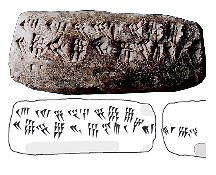
Working with large numbers has been part of civilization for thousands of years. Ancient Babylonia, knowledge in the general Mesopotamian geographical area, and the Sumerian civilization from before 3500 BC dealt with such things as the 20th power of 20: 104,857,600,000,000,000,000,000 (or in words "104 quintillions, 857 quadrillions and 600 trillions"). Excerpts above are from a web site by Ernest Moyer - see [11] - as is the image of the cuneiform representing that number:: cuneiform

The Sumerians used 60 as a base or unit of numbering. This the reason that we divide a minute into 60 seconds and an hour into 60 minutes. They were aware of the precession of the equinoxes, the phenomenon that leads to an annual lag of ' ... 50 seconds (something that is) ... in 25,920 years ... 360 degrees, one complete cycle of the zodiac, or ... one "Great" or Platonic Year".' Other 'number relationships were known in ancient times ... 25,920 divided by 60 ... yields ..."432." ... "540 times 800 is 432,000, which is the number given by Berossos (learned Babylonian priest) for the sum of years of the antediluvian kings. ... (A) number in Europe ... India .. and in Mesopotamia ... (used as a) measure of a cosmic eon."' (Both quotations from [10, pp. 116-118 (1962)].) The Sumerian year without the annual five festival days consisted of 72 five-day weeks: the product of 72 and 360 is 25,920. The fourth power of 60 or 60x60x60x60 is 12,960,000; twice 12,960 is 25,920.

Theory


Factorial is defined only on integers. The Gamma Function has the same values at integer arguments but also exists numerically in between them. Approximating values is another option; see Stirling's Formula and [1, p. 257]. There is a wealth of information on Real and Complex arguments, along with identities, approximations, and references at [3]. The derivation of Stirling's Formula and the relationship between the Gamma Function and factorial is through infinite series, calculus, and exponential and logarthmic functions.
See other factorial definitions. Much more is known about factorial.

Factorial occurs in Combinatoric areas - problems where counting must take place. For instance, the fifty-two card game Hearts can be played with three or more. When there are three, each has a seventeen-card hand. How many ways can one's hand be arranged? The answer is 17! - we found that value above, so there are 355,687,428,120,000 arrangements. The first move in a game of hearts is to select three cards to pass: the number of ways to do that comes from partitioning the seventeen into two groups, one of three, the other fourteen cards. The arrangements of the three, and those of the fourteen are respectively, 3! and 14! many. If we divide 17! by these two expressions we get exactly the number of ways we can choose three from the seventeen. It is fairly easy to see that this number is
(17)(16)(15)/(3)(2)(1) = (17)(8)(5) = (17)(40) = 680. For more on counting in both solid objects and computer codes see [4a].

Applications

  1. Large numbers provide keys to encode transactions. The analysis of that topic is part of a field of computer communications. Transmitting images from space to the earth's surface so they are not corrupted by noise, involves using ideas from this area. Secure transfer of funds depends on being unable to factor a large number rapidly. A systematic development of the underlying topics appears in [4b] which gives another number in the range of the quantity 63.2 * 1063, namely 52! A Stirling's formula approximation to that quantity is given as 8.053 * 1067 [4b, p. 47].


  2. Two large numbers satisfy a simply-stated property in a situation where so far we don't know of any others that do so:

    4700063497 . The much larger quantity below was recently found. Begin below (discusses newest large number satisfying that property). Go to the preceding link second (electronic mail about current research on this issue).

    63130707451134435989380140059866138830623361447484274774099906755 ... or in Words (please click).

    The size of 4700063497 can be stated two ways. The ordinary approach uses commas. Every three-digits group is then seen visually. Such words as thousand, million help us say things. This number, namely 4,700,063,497, is more than four thousand seven hundred million. Put another way, it is more than four billion. The other method applies exponents. It says that the quantity is 4.700063497*109 in scientific or exponential notation.

    The following quotation (from Frank Pilhofer's web page Googolplex which cites the American Heritage Dictionary) expresses another way to describe very large numbers.

    "Edward Kasner once asked his nine-year-old nephew (Milton Sirotta) to invent a name for a very large number, ten to the power of one hundred; and the boy called it a googol. He thought this was a number to overflow people's minds, being bigger than anything that can ever be put into words. Another mathematician then shot back with Googolplex, and defined it to be 10 to the power of Googol" (quotes from Googolplex).

  3. From the discussion above we know that this is a true statement:

    4,700,063,497 < 17!


  4. Here is a problem in factorials. Find the value of m so that this is a true statement:

    m! < 4,700,063,497 < (m+1)!

    The answer can be found by Approximating Factorials or Exact Calculation.


  5. This is a difficult problem in factorials. Find the value of m so that this is a true statement:

    m! < 63,130,707,451,134,435,989,380,140,059,866,138,830,623,361,447,484,274,774,099,906,755
    < 63.2(1063) < (m+1)! Answer


  6. One approach to the preceding is to use the method for estimating the size of 17! by replacing its factors by 10.

  7. Use the two tables 6.5, 6.6 [1, p. 276] to find n! for these values of n: 100, 500, 1000.

  8. Instead of bounding the two values in 3. and 4. by factorials one can get closer using the Gamma function. Seek values r so each is between Gamma(r) and Gamma(r + 10^-6) [the Gamma function at an argument a millionth above the lower one, r]. Calculated.

  9. Use the quantity googol here: i.e., a 1 followed by 100 zeros or 10100. Express or bound the numbers:

    63,130,707,451,134,435,989,380,140,059,866,138,830,623,361,447,484,274,774,099,906,755!

    and

    4,700,063,497!

    in terms of googol notation.


  10. Ackermann's function [2, Dictionary of Algorithms and Data Structures]

    (algorithm)

    Definition: A function of two parameters whose value grows very fast.

    Formal Definition:

    * A(1, j)=2j
    * A(i, 1)=A(i-1, 2)
    * A(i, j)=A(i-1, A(i, j-1))

    Note: In 1928, Wilhelm Ackermann (1896 - 1962) observed that A(x,y,z), the z-fold iterated exponentiation of x with y, is an example of a recursive function which is not primitive recursive. A(x,y,z) was simplified to a function of 2 variables by Rosza Peter whose initial condition was simplified by Raphael Robinson. Ackermann was a student of David Hilbert.


  11. Mathematica gives these values for the factorial of the numbers 1, 2, ..., 20:

    1, 2, 6, 24, 120, 720, 5040, 40320, 362880, 3628800, 39916800, 479001600, 6227020800, 87178291200, 1307674368000, 20922789888000, 355687428096000, 6402373705728000, 121645100408832000, 2432902008176640000

Choice of 17 was arbitrary, but it is the natural result from dividing 52 in three. This happens when three people play the card game hearts. For the hearts rules see Board and Card Games.

The material continues with two urls that begin with words about size: the first provides material about big and small numbers. The second relates to aspects of the human body's size. Other continuations, emphasize scientific notation. There are exercises and explanations Math & Physics, an interactive tool for number conversion, Practice Converting, and an Online Encyclopedia.

References

[1] Abramowitz, M. and Stegan, I., eds., Handbook of Mathematical Functions - With Formulas, Graphs, and Mathematical Tables, National Bureau of Standards, Applied Mathematics Series, 55, June 1964, Tenth Printing, December 1972, with corrections.

[2] Black, P., Dictionary of Algorithms and Data Structures, National Institute of Standards and Technology, 1998.

[3] Weisstein, E., World of Mathematics, CRC Press LLC, 1999; 1999-2002, Wolfram Research, Inc.

[4] Golomb, S., Polyominoes [with more than 190 diagrams by Warren Lushbaugh, NY: Charles Scribner's Sons, 1965], [4a] "Chapter V: Some Theorems About Counting," [4b] Second Edition, Princeton NJ: Princeton Univ. Press, 1994, 1965.

[5] Knuth, D., Fundamental Algorithms, Second Edition, Reading MA: Addison-Wesley, 1973, 1968, pp. 44-73.

[6] Pilhofer, Frank, email fp@fpx.de, http://www.fpx.de/fp/Fun/Googolplex/, March 20, 2002.

[7] Rules, http://www.everyrule.com .

[8] Iverson, Kenneth E., "Notation as a Tool of Thought," Communications of the Association for Computer Machinery, 23(8): 444-465, 1980.

[9] Gardner, Martin, The Numerology of Dr. Matrix.

[10] Campbell, Joseph, The Masks of God: Oriental Mythology.

[11] Moyer, Ernest, PO Box 1206, Hanover, PA 17331, USA; web site http://www.egyptorigins.org/; email address given there.

[12] Davis, Philip J. and Hersh, Reuben, The Mathematical Experience, Boston, MA: Birkhauser, 1981.
30 May 2009 Version http://www.cs.ucla.edu/~klinger/nmath/size_5_30_09.html
©2009 Allen Klinger