|
|
Pictorial cues, however,
are intrinsically ambiguous, in that the prior assumptions cannot be validated.
For instance, the "blur image"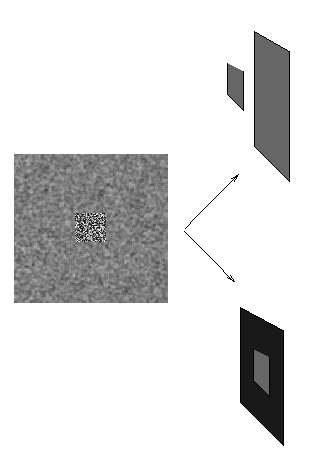 could
be interpreted as two squares with similar spatial frequency content placed
at different depths, or as a square with high spatial frequency content
surrounded by a frame with low spatial frequency, all at one depth. In
this sense pictures are illusions, in that they are
three-dimensional
scenes different than the true scene that generate the same image.
could
be interpreted as two squares with similar spatial frequency content placed
at different depths, or as a square with high spatial frequency content
surrounded by a frame with low spatial frequency, all at one depth. In
this sense pictures are illusions, in that they are
three-dimensional
scenes different than the true scene that generate the same image. As
another example, just by looking at this picture, you could not distinguish
Jerry from a cardboard copy of himself (but try clicking on the image ...)
As
another example, just by looking at this picture, you could not distinguish
Jerry from a cardboard copy of himself (but try clicking on the image ...)
CONTROLLABLE
CUES
Controllable Cues, unlike
pictorial ones, are not present in one single image. Rather, they
are associated with variations among different images of the same scene.
For
instance, when we take images of a scene from a changing viewpoint
we have either the "Stereo" cue (2 images) or the "Motion" cue (several
images). Stereo and Motion are two manifestations of the so-called Parallax
cue, that is measurable properties of images that are associated
with a change of the viewpoint. 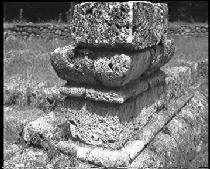 As
another example, consider different images of the same scene taken with
different geometry of the imaging device. For instance, the human eye can
change the shape of the lens to make the aperture larger or smaller, or
to accommodate points at different depths. Similarly, in a camera one can
change the aperture of the lens and its focus. Measurable properties
of images that are associated with a change in the geometry of the imaging
device are called Accommodation cues.
As
another example, consider different images of the same scene taken with
different geometry of the imaging device. For instance, the human eye can
change the shape of the lens to make the aperture larger or smaller, or
to accommodate points at different depths. Similarly, in a camera one can
change the aperture of the lens and its focus. Measurable properties
of images that are associated with a change in the geometry of the imaging
device are called Accommodation cues. 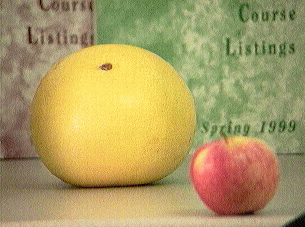
The peculiarity of controllable
cues is that, unlike pictorial cues, they can provide unambiguous information
about the three-dimensional shape and motion of a scene, as we will
see later.
EXOGENOUS
CUES
To complete the picture,
one could also consider Exogenous cues, that is cues that are associated
with the introduction of known structures in the scene, as for instance
when projecting structured light or shadows into the scene.