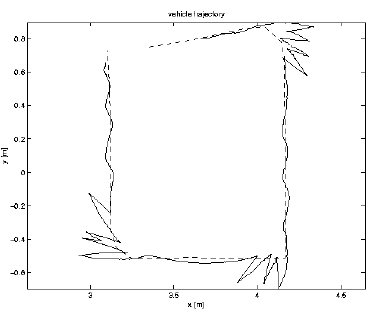
- A Lagrangian formulation of non-holonomic path following (in "The Confluence of Vision and Control", Springer Verlag, 1998)
- Model-based predictive output tracking (in Proc. of the CDC 1998)
- Visual path following by recursive spline updating (Proc. of the CDC 1997)
surgery.
The basic idea behind our approach, which was championed by Frezza and Picci (Proc. of the CDC 1995), is to formulate the tracking problem as a constrained approximation of the desired path with feasible trajectories of the vehicle. The result is a novel control scheme in which estimation and control are mixed together.
In certain applications (such as driving or endoscopic surgery), performance may be subject to hard constraints (we don't care that we follow the trajectory "on average"; we need to do so within a prescribed error at all times!). The problem is, then, finding an ${\cal L}_\infty$ approximation of the observed portion of unknown contour with feasible trajectories.
In this project, the operational aspect of vision is emphasized, so that knowledge and representation of the environment is only functional to the accomplishment of a control task.