A Survey of Deep Learning for Mathematical Reasoning
Pan Lu, Liang Qiu, Wenhao Yu, Sean Welleck, and Kai-Wei Chang, in ACL, 2023.
Download the full text
Abstract
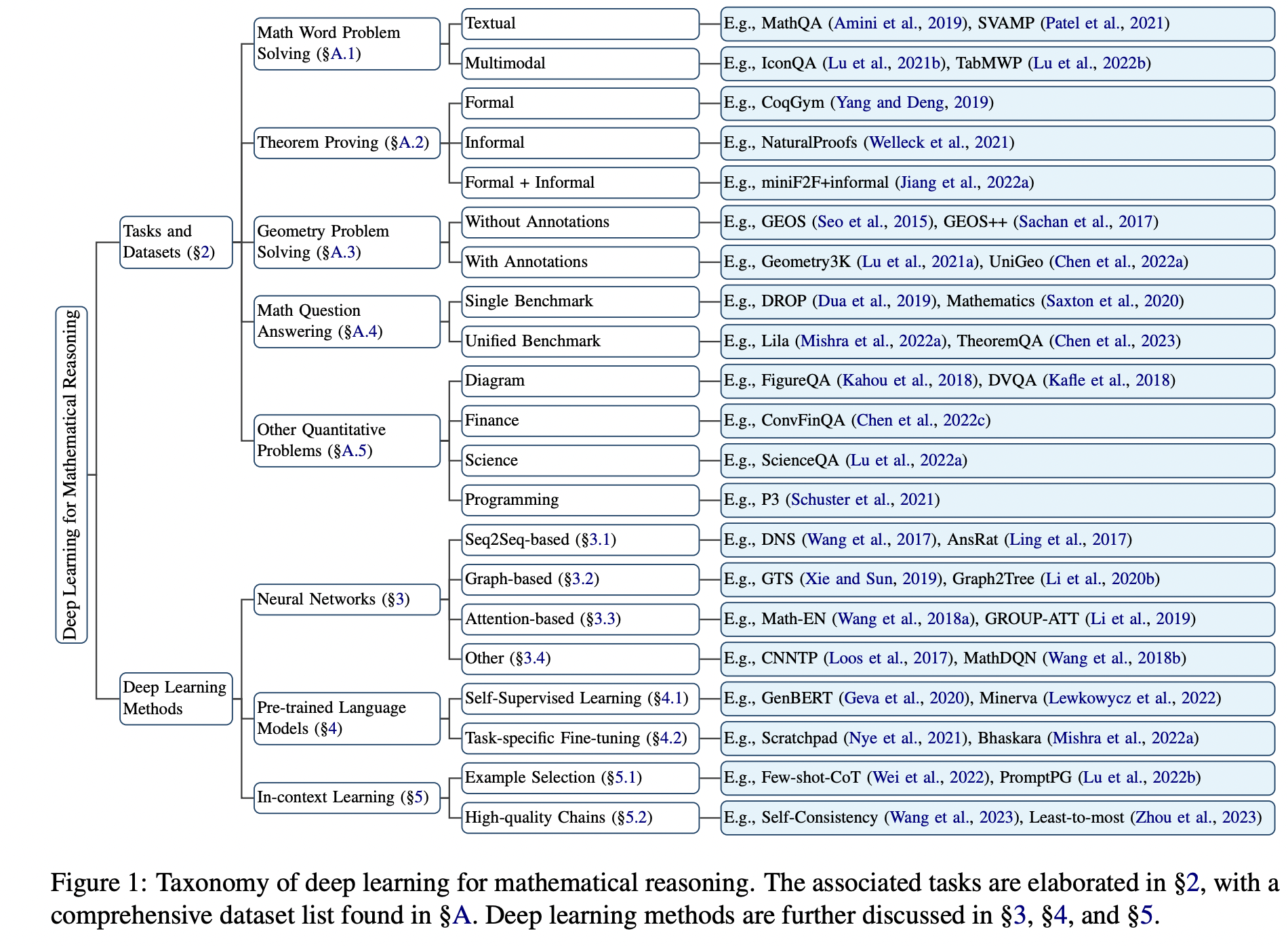
Mathematical reasoning is a fundamental aspect of human intelligence and is applicable in various fields, including science, engineering, finance, and everyday life. The development of artificial intelligence (AI) systems capable of solving math problems and proving theorems has garnered significant interest in the fields of machine learning and natural language processing. For example, mathematics serves as a testbed for aspects of reasoning that are challenging for powerful deep learning models, driving new algorithmic and modeling advances. On the other hand, recent advances in large-scale neural language models have opened up new benchmarks and opportunities to use deep learning for mathematical reasoning. In this survey paper, we review the key tasks, datasets, and methods at the intersection of mathematical reasoning and deep learning over the past decade. We also evaluate existing benchmarks and methods, and discuss future research directions in this domain.
Bib Entry
@inproceedings{lu2023survey,
  author = {Lu, Pan and Qiu, Liang and Yu, Wenhao and Welleck, Sean and Chang, Kai-Wei},
  title = {A Survey of Deep Learning for Mathematical Reasoning},
  booktitle = {ACL},
  year = {2023},
  presentation_id = {https://underline.io/events/395/posters/15337/poster/76360-a-survey-of-deep-learning-for-mathematical-reasoning}
}
Related Publications
- AVIS: Autonomous Visual Information Seeking with Large Language Models, NeurIPS, 2023
- Chameleon: Plug-and-Play Compositional Reasoning with Large Language Models, NeurIPS, 2023
- Symbolic Chain-of-Thought Distillation: Small Models Can Also "Think" Step-by-Step, ACL, 2023
- On the Paradox of Learning to Reason from Data, IJCAI, 2023
- Dynamic Prompt Learning via Policy Gradient for Semi-structured Mathematical Reasoning, ICLR, 2023
- Learn to Explain: Multimodal Reasoning via Thought Chains for Science Question Answering, NeurIPS, 2022
- Semantic Probabilistic Layers for Neuro-Symbolic Learning, NeurIPS, 2022
- Neuro-Symbolic Entropy Regularization, UAI, 2022