Robustness Verification for Transformers
Zhouxing Shi, Huan Zhang, Kai-Wei Chang, Minlie Huang, and Cho-Jui Hsieh, in ICLR, 2020.
CodeDownload the full text
Abstract
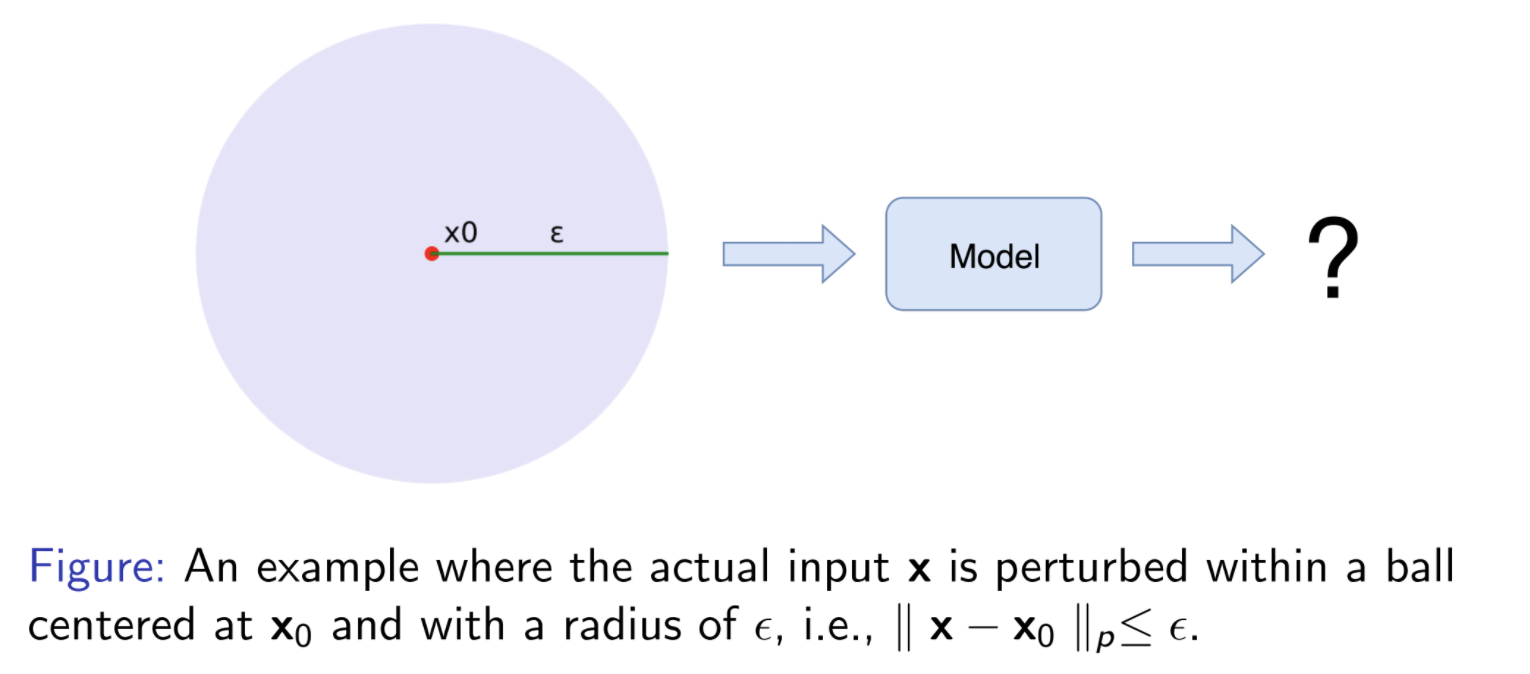
Robustness verification that aims to formally certify the prediction behavior of neural networks has become an important tool for understanding the behavior of a given model and for obtaining safety guarantees. However, previous methods are usually limited to relatively simple neural networks. In this paper, we consider the robustness verification problem for Transformers. Transformers have complex self-attention layers that pose many challenges for verification, including cross-nonlinearity and cross-position dependency, which have not been discussed in previous work. We resolve these challenges and develop the first verification algorithm for Transformers. The certified robustness bounds computed by our method are significantly tighter than those by naive Interval Bound Propagation. These bounds also shed light on interpreting Transformers as they consistently reflect the importance of words in sentiment analysis.
Our #ICLR2020 paper, Robustness Verification for Transformers, presents the first algorithm for verifying Transformers (w/ Huan Zhang, @kaiwei_chang, Minlie Huang and Cho-Jui Hsieh) . It's available at https://t.co/1tXyBVKSnS and https://t.co/Q4fc5cnlZ3.
— Zhouxing Shi (@zhouxingshi) February 18, 2020
Bib Entry
@inproceedings{shi2020robustness,
  author = {Shi, Zhouxing and Zhang, Huan and Chang, Kai-Wei and Huang, Minlie and Hsieh, Cho-Jui},
  title = {Robustness Verification for Transformers},
  booktitle = {ICLR},
  year = {2020}
}
Related Publications
- VideoCon: Robust video-language alignment via contrast captions, CVPR, 2024
- CleanCLIP: Mitigating Data Poisoning Attacks in Multimodal Contrastive Learning, ICCV, 2023
- Red Teaming Language Model Detectors with Language Models, TACL, 2023
- ADDMU: Detection of Far-Boundary Adversarial Examples with Data and Model Uncertainty Estimation, EMNLP, 2022
- Investigating Ensemble Methods for Model Robustness Improvement of Text Classifiers, EMNLP-Finding (short), 2022
- Unsupervised Syntactically Controlled Paraphrase Generation with Abstract Meaning Representations, EMNLP-Finding (short), 2022
- Improving the Adversarial Robustness of NLP Models by Information Bottleneck, ACL-Finding, 2022
- Searching for an Effiective Defender: Benchmarking Defense against Adversarial Word Substitution, EMNLP, 2021
- On the Transferability of Adversarial Attacks against Neural Text Classifier, EMNLP, 2021
- Defense against Synonym Substitution-based Adversarial Attacks via Dirichlet Neighborhood Ensemble, ACL, 2021
- Double Perturbation: On the Robustness of Robustness and Counterfactual Bias Evaluation, NAACL, 2021
- Provable, Scalable and Automatic Perturbation Analysis on General Computational Graphs, NeurIPS, 2020
- On the Robustness of Language Encoders against Grammatical Errors, ACL, 2020
- Learning to Discriminate Perturbations for Blocking Adversarial Attacks in Text Classification, EMNLP, 2019
- Retrofitting Contextualized Word Embeddings with Paraphrases, EMNLP (short), 2019
- Generating Natural Language Adversarial Examples, EMNLP (short), 2018