On the Robustness of Language Encoders against Grammatical Errors
Fan Yin, Quanyu Long, Tao Meng, and Kai-Wei Chang, in ACL, 2020.
Slides CodeDownload the full text
Abstract
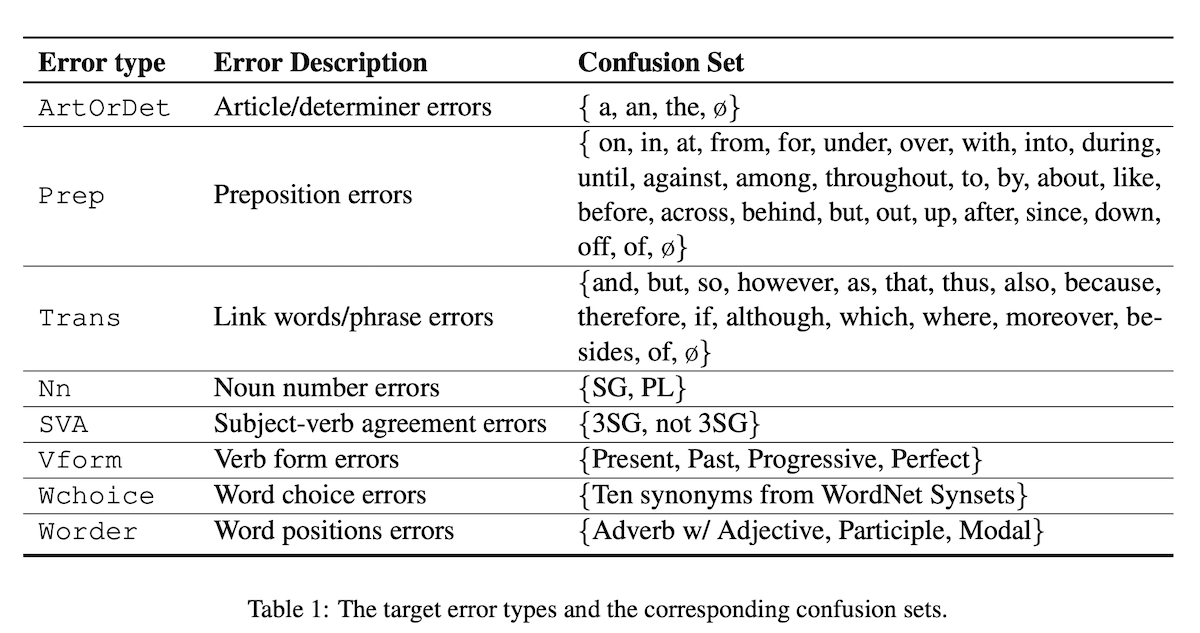
We conduct a thorough study to diagnose the behaviors of pre-trained language encoders (ELMo, BERT, and RoBERTa) when confronted with natural grammatical errors. Specifically, we collect real grammatical errors from non-native speakers and conduct adversarial attacks to simulate these errors on clean text data. We use this approach to facilitate debugging models on downstream applications. Results confirm that the performance of all tested models is affected but the degree of impact varies. To interpret model behaviors, we further design a linguistic acceptability task to reveal their abilities in identifying ungrammatical sentences and the position of errors. We find that fixed contextual encoders with a simple classifier trained on the prediction of sentence correctness are able to locate error positions. We also design a cloze test for BERT and discover that BERT captures the interaction between errors and specific tokens in context. Our results shed light on understanding the robustness and behaviors of language encoders against grammatical errors.
How grammatical errors affect language encoders?🧐Our #acl2020nlp: "On the Robustness of Language Encoders against Grammatical Errors"(https://t.co/0mw3hYkNhE w/Fan Yin, Quanyu Long, Tao Meng) diagnoses encoders by simulating grammatical errors with adversarial attacks. #NLProc
— Kai-Wei Chang (@kaiwei_chang) June 11, 2020
Bib Entry
@inproceedings{yin2020robustness,
  author = {Yin, Fan and Long, Quanyu and Meng, Tao and Chang, Kai-Wei},
  title = {On the Robustness of Language Encoders against Grammatical Errors},
  booktitle = {ACL},
  presentation_id = {https://virtual.acl2020.org/paper_main.310.html},
  year = {2020}
}
Related Publications
- VideoCon: Robust video-language alignment via contrast captions, CVPR, 2024
- CleanCLIP: Mitigating Data Poisoning Attacks in Multimodal Contrastive Learning, ICCV, 2023
- Red Teaming Language Model Detectors with Language Models, TACL, 2023
- ADDMU: Detection of Far-Boundary Adversarial Examples with Data and Model Uncertainty Estimation, EMNLP, 2022
- Investigating Ensemble Methods for Model Robustness Improvement of Text Classifiers, EMNLP-Finding (short), 2022
- Unsupervised Syntactically Controlled Paraphrase Generation with Abstract Meaning Representations, EMNLP-Finding (short), 2022
- Improving the Adversarial Robustness of NLP Models by Information Bottleneck, ACL-Finding, 2022
- Searching for an Effiective Defender: Benchmarking Defense against Adversarial Word Substitution, EMNLP, 2021
- On the Transferability of Adversarial Attacks against Neural Text Classifier, EMNLP, 2021
- Defense against Synonym Substitution-based Adversarial Attacks via Dirichlet Neighborhood Ensemble, ACL, 2021
- Double Perturbation: On the Robustness of Robustness and Counterfactual Bias Evaluation, NAACL, 2021
- Provable, Scalable and Automatic Perturbation Analysis on General Computational Graphs, NeurIPS, 2020
- Robustness Verification for Transformers, ICLR, 2020
- Learning to Discriminate Perturbations for Blocking Adversarial Attacks in Text Classification, EMNLP, 2019
- Retrofitting Contextualized Word Embeddings with Paraphrases, EMNLP (short), 2019
- Generating Natural Language Adversarial Examples, EMNLP (short), 2018